


Inside Tom Freston’s Wild Ride From ‘I Want My MTV!’ to $3 Billion in Revenue
- Nov 13, 2025
- 10 min read
Updated: Nov 14, 2025

By Holly Peterson
Illustration by Lorenzo Alessandro for WSJ. Magazine
Nov. 13, 2025 1:23 pm ET
Success, they say, is inspiration plus perspiration. But what of sheer universe-vibration? We ask the most successful people we know to tell us what role luck plays in one’s career.
IN THE EARLY DAYS of MTV, the receptionist sold cocaine and the office had one clothing rule: no frontal nudity. Such was the circus atmosphere of the place, according to Tom Freston, whose memoir, “Unplugged,” reveals how a team of die-hard believers turned music into television.
By 1969, he’d earned an M.B.A., but soon after nixed his banker-bro side part, quitting his job at Benton & Bowles advertising firm. Why? He says talking about mouthwash or toilet paper for hours with clients “didn’t turn me on.”
Instead, Freston hopscotched the globe for a decade, living in Southeast Asia as he launched a multimillion-dollar clothing business. Returning to the U.S. in 1979, he became part of the initial squad that launched MTV in August 1981 with a paltry 160 music videos.
Freston’s unusual and messianic marketing department got megastars like David Bowie and Mick Jagger to scream, “I Want My MTV!”—a campaign designed to strong-arm cable systems into carrying the fledgling station. Between seductive advertisements and must-see videos, Freston and his cohorts had made enough noise by 1985 that Viacom decided to purchase MTV Networks for $550 million (a deal that included Nickelodeon and VH1). Two years later, Sumner Redstone made a hostile bid for Viacom, buying the company for $3.4 billion.
Freston drove consistent double-digit growth for 17 years; by 2001 the company had reached $3 billion in revenue—the shiniest gem in the Viacom universe. Hiring misfits and creative oddballs, Freston and his team launched Comedy Central and stars including Bill Maher, Jon Stewart, Jimmy Kimmel, Stephen Colbert and John Oliver.
MTV is back in the headlines, with David Ellison’s Paramount looking to revive its legacy with younger listeners—a tough road, given that the median MTV audience is now 56 years old, according to Nielsen, and that the brand’s cachet faded in the post-Freston era with the rise of digital media. Here, the CEO who built the company into a juggernaut talks about how the unconventional network fought its way into the mainstream.
You had an M.B.A. and were living in a chicken coop without running water. Were you a super-scruffy dude?
I had rocking chairs and made it kind of nice. It wasn’t out of line with the people I was hanging out with, or the spirit of 1970. I’d had every menial job imaginable.
Post-M.B.A., you surfed in Sri Lanka, hiked in Nepal, rode horses in Afghanistan and didn’t call your parents—or anyone. Not once?
With no social media, no one knew where the hell you were. I reveled in that disorientation. To call from Asia, you had to scream and yell. It cost a fortune. Humility, self-awareness, cultural nuance and confidence is the great gift of travel. That’s a good attribute to have as a manager, particularly for the kind of business that I came to preside over at MTV Networks and Viacom.

Tom Freston in Afghanistan’s Hindu Kush in 1973.
What aspect of office life were you bad at?
Glad-handing. When I worked at [advertising firm] Benton & Bowles and I was on the Procter & Gamble track, I would have a hard time going out with clients and talking about mouthwash for three or four hours. It didn’t turn me on.
What turned you on about music videos? Were you a music guy in high school?
I had an encyclopedic knowledge of music and songs, like Elvis, the Everly Brothers and Little Richard. I never had any idea that one day this would be valuable information for me.
Tell me about the early MTV culture. Were people smoking weed in the office all the time?
Actually, no. But I had the worst-dressed group of people at any office building in Manhattan. The only dress-code rule was no frontal nudity. It was not a traditional company. But it wasn’t like everyone was stoned all the time. People were working their asses off. It was a more raucous kind of wild place where everybody was on a crusade to sweep the nation with this musical invention. We were lucky in that it was an ascendant business at the time.
Music videos already existed, but MTV exploded the concept. What videos were the most catalytic at the time?
Aerosmith and Run-DMC “Walk This Way.” It made the rock ’n’ roll hip-hop connection between two distinct groups of youth-culture fans. Madonna’s “Like a Prayer” video with more overt sexuality in a church setting created a big furor, because Pepsi-Cola, who was a big advertiser, came in and said, “If you run this video, we’re gonna have to pull all our advertising.”
Did you hesitate before running it?
No way. You couldn’t be caught caving to an advertiser. That’s the big no-no.

Freston and Mick Jagger, circa 1987.
When running an entertainment company, should you cater more to corporate goals or customer tastes? Choose one.
More the customer. We had to get inside the customer’s head, because we were going after specific audiences. If we failed in making a connection with viewers, we didn’t have a business.
Do you think fans today are loud enough about sharing opinions, pro or con, about the ABC or CBS settlements with the Trump administration?
The telling story is the Jimmy Kimmel episode. I like Bob Iger. I have great respect for him. In trying to avoid one problem by bending the knee to Trump, he put in play a larger problem. Young people who have an affinity towards someone on television do not like it at all when it’s taken away from them, and they will make a lot of noise that will cause you reputational and economic damage. There must have been 30, 40, 50 instances where I had that experience with MTV always being dropped by cable operators where we had to fight to get it back, and we always won. Our viewers always came to our rescue.
How many times did you take LSD?
A handful of times. I was never a big druggie, but I had some profound experiences with psychedelics. I’m definitely a believer that there are therapeutic applications for these drugs
today. It feels cliché, but you do feel some sort of peaceful connection to everything in the universe. It’s certainly working for alcoholism and PTSD.
You were more of a corraller than a content creator, but you shared the same sophomoric humor with the animation guys who put Comedy Central into the stratosphere: “South Park,” “Beavis and Butt-Head,” “SpongeBob SquarePants.”
We cracked the original animation model, the opposite of what was done by some factory development squad at Hanna-Barbera. I said, Let’s find the type of pot-smoking guys in high school in the back of the class that draw well and have some character living inside their heads, like this hippie Steve Hillenburg who made “SpongeBob.” And let’s get these guys who don’t know anything about how to make a series and school them and we’ll crank it out.
It took you a quick minute to greenlight “South Park.” How’d you know so fast?
It’s just right away, Wow. Who wouldn’t want to see this? This is hilarious. Who are these guys? Let’s put these guys in business. We added 30 million subscribers to Comedy Central because of the first episode. We had six episodes of “South Park” in the first batch they made. People ordered cable just to see it.

Sumner Redstone outside MTV’s Video Music Awards in 1992. Redstone had assumed control of Viacom, which owned MTV Networks, in a hostile takeover a few years earlier.
You say hipness evaporates without regular reinvention. Did you ever feel unhip?
First of all, a hip person never really thinks about hipness. But MTV’s hipness quotient would allow us to be more powerful than we ordinarily would be—advertisers would pay more, people would want to be associated with us. But you don’t keep hipness, unless you die young, like Jimi Hendrix. Or regularly reinvent yourself to be on the leading edge.
What role did luck play with MTV? Do you believe in pure luck? Or do you believe professionals earn it?
I believe in both kinds of luck. In the office you make your luck in a way. You put yourself in a position where things can happen to you, and you prepare for them. But a lot happens through serendipity. After Viacom took us over, Sumner Redstone started buying up stock. He wanted to take over the company and oust the current Viacom management and begin his own entertainment empire. And Bob Pittman called me one day and said, “[Redstone] wants to know more about the company. Will you go see him at a secret meeting in his room in the Carlyle Hotel in New York?” Because I did that, I endeared myself to him and helped him, in a way, make the decision to go ahead and buy the company.
Tell me about when MTV was bought and the grown-ups took over.
In 1985, when Viacom bought MTV Networks, cost-control guys took over who were lacking vision for what the company could become. They were hard-nosed, proper business people. And they came to this company retreat in Montauk [N.Y.], instantly saying in a speech, “We’ve talked to our lawyers, and we don’t think we have to pay your stock options out.” Nothing about “Hey, we see a great future for you ahead, and we love what you’ve done so far and accomplished.” And next they take off in their helicopters.
Did you sense that the party was ending? That the fun, O.G. squad had lost power?
We were pissed off, and everybody went to the bar, and one thing led to another. Bob Pittman started throwing glasses against the wall. And then, you know, next thing I know, palm trees, plants are being slammed, fish tanks turned over. We got thrown out of Tribeca Grill, which we busted up as well, and they threw us out on the street.
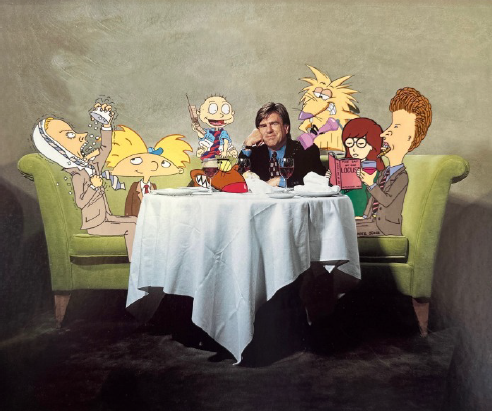
Freston surrounded by the animated characters from some of his networks’
TV shows, including ‘Beavis and Butt-Head,’ ‘Hey Arnold’ and ‘Rugrats.’
Terry Doyle
Was there ever a time when you started to feel like a suit yourself? When you said, Wow, my behavior is really suitish; I’m officially one of them.
There were times in 17 years of running MTV Networks, as a nontraditional company. The bigger we got, the more we got under the microscope. Double-digit growth top and bottom line every year, so Sumner ruled us with a light touch. That said, once I was president and then CEO of Viacom, I had to deal with more unpleasant stuff and was tormented by Sumner, earnings calls and unpleasant suit stuff to me. I would be resentful. When he offered me the top job, I had to think, “Jesus, I don’t have to work for this guy. That means I’m going to be fired, because he fired all my predecessors. That means I’m not going to be close to the things I love to do.” But you know, let’s be a big boy. Put on your big-boy pants. Maybe it’s time to do it.
Was that the only way you were tormented by Sumner Redstone? I know you share some, shall we say, colorful stories about him in the book.
No. I was on a worldwide quest to take MTV everywhere. In the late ’80s and ’90s, countries began to deregulate media, satellite dishes multiplied on roofs. I kept saying, “Sumner, you got to come to Asia. You’re not going to believe what’s going on there.” So he called me up to his office one day, says, “I’m really finally ready to go to Asia. I’d like to go.” I said, “Well, let me figure out some places for you to go that could do the most good for us. Obviously, we could go to Shanghai, we could go to Taipei, we could go to Mumbai.” And he says, “I’d like to go to Bangkok, just Bangkok.” I told him we didn’t do any business in Thailand, but he insisted on going. We got to Bangkok and he said, “I’d like to go to some sex clubs.” I said, “Oh, my. OK.” Sumner had this gleam in his eye, and he wanted to see some sex.
Were you embarrassed?
Terribly. There’s shows where people have sex. He was transfixed. They kind of run through the Kama Sutra catalog. And they do, say, acrobatic tricks with ping-pong balls. I sat behind him. I’d only been to a sex club once, years before. That was not my thing. And I used to wonder how these girls end up here. How’s this happening? On the other hand, in Bangkok we had a meeting with the [Charoen Pokphand Group], and Sumner was fantastic. He made such a great case for Viacom and why we should do some business together. I don’t mean to demean his abilities as a businessman.
But as the internet took over you were unable to adapt his entertainment conglomerate to the digital tidal wave. What could you have done differently?
We could have started a separate corporation outside of the rules of the legacy media company and hired a lot of engineers from Google or whatever and started our own thing.
That doesn’t count. I’m talking within the legacy Viacom tent.
No one was able to transform themselves into a digital-first company. Viacom were like the canaries in the coal mine because our younger audiences were the first to really start turning towards the internet. Viacom had a certain performance they had to show Wall Street. They couldn’t sink into losses. So we were constrained in terms of what we could buy. We just couldn’t start up something and have it lose money for a decade, like it was Facebook.

From left, Brad Grey, Freston and Tom Cruise in 2005.
Alex Berliner
Was there anything you did personally that made the transition harder? Any regrets?
If I had a regret, I would say that I didn’t push hard enough with YouTube, because we were the leaders in short-form video on MTV, VH1, Comedy Central. YouTube started in 2005, and all of a sudden, anybody can be a pro. Now it’s worth $500 billion. The Viacom board felt that YouTube was a copyright infringement machine. We made acquisitions of websites that never really amounted to much.
It seems like the only choice a legacy company had at the turn of the century was to create more content and become irresistible.
Yes. Take Disney as an example. They realized they weren’t going to set up some social network. What they could do would be to triple down on buying production companies and make Pixar or Lucasfilm or Marvel. Let’s amass more content under our roof so we are more invincible to these forces. And when they started a streaming service, they had a lot of ammunition. Now they have to prove that they can compete with Netflix.
In September 2006, Sumner fired you in part for not buying Myspace when it sold to Rupert Murdoch for over $500 million. Sumner didn’t know at the time that you were
right, that Justin Timberlake and Specific Media would later buy it for only $35 million. So he fired you. Tell me about that.
He said, “I have terrible news for you and me. The board wants me to fire you.” I didn’t say anything to him. I just got up and left on the advice of my lawyer, Allen Grubman.
Did you at least give him a look?
Yeah, a look like, “What the f—? Are you kidding me?” I mean, you’re telling me the board’s making you do this. You control the board. That’s a joke.
This interview has been edited and condensed for clarity.
This article appears in the WSJ. Magazine.
Holly Peterson is a journalist and the author of six books, including the novels “The Manny” and “It Happens in the Hamptons.”